|
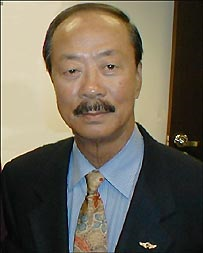
Speech by Gen Nguyen Cao Ky, 13 Jun 2003
* * *
Students, faculty, administrators and staff, I thank you for
this opportunity to share a few thoughts. I am particularly indebted to
President Martha Kanter and to Dean John Swensson for your kind invitation to
speak today.
Twenty-seven years ago last April, after 20 years of heroic resistance, South Vietnam
fell to the enemy. Much has happened since. Many of you were not yet born-but
those who still recall that dark day, those to whom over the years time has
added lines to your faces and gray to your heads, who served through those
difficult times with honor-you have not lost the dedication to liberty
inspired by your high ideals. You have matured, and the sacrifices and
passions of your youth have given way to the rewards and responsibilities
that accompany your positions of esteem in American society. As for me, as
you can see, I am no longer wearing my purple scarf, my flight suit, my
six-shooter. I have put them all away at the bottom of my trunk, memorabilia
of a time past.
If the war has faded into history, democracy's defeat in Vietnam has left deep marks in
the consciousness of both nations. The questions asked since 1975 have yet to
bring satisfactory answers. How could an alliance of the 25 million people
and armed forces of South Vietnam with the colossal American political,
economic and military apparatus, along with the forces of other allied
nations, have been defeated by the small, impoverished people and army of
North Vietnam?
Today I will offer my own answers to those questions.
LADIES AND GENTLEMEN:
American history books postulate that the war was lost
because it lacked legitimacy, because of corruption in the government and
armed forces of South Vietnam, because of the cowardliness of South
Vietnamese troops, because America abandoned South Vietnam, and so forth.
None of these, however, is accepted as definitive.
I say to you now: We lost the war for two reasons: Because of the
ill-conceived, unequal, and often condescending relationship between the United States and South Vietnam.
And because our overall strategy was defensive war, a strategy that by itself
would have led to failure and eventual defeat.
And how did this happen, exactly? As someone born and raised during that war,
one who participated in and led it, who has witnessed and shared in the
sufferings of his country and of his people, I will attempt to present as
objectively as I can the facts and observations that lead me to such a bold
statement. Tonight, as difficult as it may be to face them, you will hear
facts that you have not heard before, and I trust you will share my
conclusions.
LADIES AND GENTLEMEN:
After the 1954 Geneva
international conference, Vietnam
was divided into two parts. On paper, North and South Vietnam were twin countries
born at the same moment. Compared to the sophisticated North, however,
the government of South
Vietnam was a very young and innocent
sibling. To explain: Many years prior to the partition, through participation
in a series of international conferences, and by pursuing a guerrilla war
against a European power, the Hanoi
leadership had demonstrated that they were a formidable political reality.
Through leadership of the fight against French colonialism,
Ho Chi Minh had made a name for himself in the international political arena.
The Hanoi
government took power with a record of resistance against the colonialists
and of struggle for national independence.
Claiming to be the liberators of the people, the North Vietnamese enjoyed
from the beginning the admiration and sympathy of the majority of the Third
World's non-aligned nations, which suffers from "oppressed peoples'
complex" and are naturally against such mighty and wealthy countries as France and the United States.
Furthermore, the North Vietnamese had the full support of the
two communist superpowers-the Soviet Union and Communist China-and
this gave them absolute confidence in their final
victory.
I would like to dwell a little on that support. We all know that without the
massive assistance of the communist superpowers, North Vietnam could not have
prolonged its war of invasion for so many years. But the Soviet
Union and Communist China were very quiet about their aid.
Indeed, during the entire war, no Soviet or Chinese official made any
statement that sounded like instructions or smacked of interference in the
internal affairs of North
Vietnam. Quite the contrary. North
Vietnamese leaders were always pushed into the international
limelight, presented as nationalists, as patriots, as fighters in a
noble cause, seeking to overthrow colonialists and imperialists, and to
liberate the oppressed people of Vietnam.
When they were later revealed as Marxist-Leninists, the Hanoi regime lost some sympathy around the
world, but continued to benefit from lingering admiration. If they no longer
had a just cause-the expulsion of a colonial power-they maintained the
appearance of legitimacy because they had no significant political
opposition. They had none, because they had taken great pains to eliminate
it.
In the South, however, things were very different. South Vietnam had to be built
from scratch and, from the very beginning, depended far too much on the
Western superpowers. As in the case of a person on public welfare, this
dependency, which became greater with each day, was quite difficult to
shake.
During the Fifties, political and military activities in Vietnam
were heavily influenced by the French, who as recent colonial masters, made
all-important decisions. The French installed as the first head of state Bao
Dai, last emperor of the Nguyen dynasty that ruled Vietnam when it was under French
domination. All the men selected to assist Bao Dai had a past that was
closely linked with the French colonial era. They had no support among those
they governed.
Only with the advent of Mr. Ngo Dinh Diem did South Vietnam have a worthy
regime and a dignified leadership. It is regrettable that within a few short
years, as power corrupts, the South Vietnamese regime deteriorated into
a family dictatorship. But it was no match for the dictatorship of the
communist party in the North. At a time when the French influence was fading
and when the American presence was directly affecting even day-to-day
decisions in South Vietnam,
a stubborn radical nationalist like Mr. Diem was bound to be overthrown.
LADIES AND GENTLEMEN:
The relationship between the US
and South Vietnam
never appeared to be a partnership between equals. Instead, our struggle for
freedom and independence became "Mr. Johnson's War."
From its inception, South
Vietnam was only considered to be an
outpost in the war against communism. Our fight for freedom was a noble
undertaking, but we committed a major political blunder because we did not
give top priority to explaining to the American and Vietnamese people that
this was not a civil war between the government and rebels in South Vietnam,
but a blatant invasion of the country of South Vietnam by another country, a
country called North Vietnam.
By the mid-sixties, the United States
had poured more than half a million troops into South Vietnam. Tens of
billions of dollars had been spent for military expenditures and economic
assistance, and even larger sums were earmarked. The American presence was
felt in every field activity, at every level of government. Even the top
leaders of South Vietnam,
including the President, were each assigned a special advisor. The American
presence and influence were strikingly blatant. So much so that the
Vietnamese man in the street referred to the US Ambassador as the Governor
General, as the French had called their top colonial official.
The influence of the American media and politicians was even
more devastating. Always emphasizing the role of the Americans in Vietnam, they transformed the Vietnam war into
a conflict between the United States
and North Vietnam,
relegating the people, the government and the armed forces of South Vietnam
to a subordinate role. This situation was further misrepresented by the
propaganda machine of international communists. The government of South Vietnam thus became, in the eyes of the
peoples of Vietnam
and of the world, a puppet regime serving the interests of American
imperialists.
Consequently, although our cause was just, we never acquired the appearance of
legitimacy necessary to win the hearts and minds of the people, an essential
ingredient of victory.
LADIES AND GENTLEMEN:
We all know that in war the political and military factors
have to complement each other. This was particularly true in Vietnam.
We were not only politically at a disadvantage, but we also committed a basic
blunder in military strategy when we chose to fight a limited and defensive
war.
The might of the US Air Force and US Navy was not used in lightning attacks
to force the enemy to his knees, as it was in Afghanistan and in the Gulf War. America
did not unleash its vaunted Strategic Air Force or its massive Seventh Fleet
to destroy enemy bases, to interdict their lines of supply on land and sea,
to blockade enemy ports.
By fighting a limited, defensive war, America permitted the enemy to
endlessly re-supply their field armies. American politicians were afraid that
the Chinese might intervene and create another Korean war. The US was and is the world's leading naval power,
but, fearing to offend the Soviets, failed to blockade Haiphong. A river of munitions flowed
through that port to be used against South Vietnam and its allies.
Long before America
decided to quit the war, I realized that this would be the inevitable result
of America's
lack of commitment to victory. I offered to lead a South Vietnamese attack on
North Vietnam,
which was defended by a single division of regular troops. All I required
from the US
was air support, and that US troops already in my country would defend
population centers. My purpose was not to conquer, but to force Hanoi to withdraw its
divisions from the South in order to defend the North, and thus to bring
about genuine peace negotiations.
You and I may not be brilliant strategists, but we should all know that the
best defense is a good offense. Moreover, even our defense was passive.
So-called "Search and Destroy" operations were kept within our
borders. Enemy territory was always a safe rear base. The enemy also used
neighboring Laos and Cambodia
to establish lines of communication, supply bases, recuperation centers for
their troops. The enemy general staff had adopted a plan of action calling on
them to always take the initiative. When their troops are strong, they would
attack, but when they were tired and weak they would withdraw to their rear
bases to rest, recuperate and regroup.
On our side, because the American people had waited too long without seeing
the light at the end of the tunnel, they became impatient. They demanded
glorious military victories, an impossible achievement in view of our totally
defensive posture. Troop morale plunged because they were asked to fight with
their hands tied behind their backs. In spite of the fact that they were
beaten back and suffered great losses, the Tet offensive of 1968 was a major
enemy victory. Even though they lost on the battlefield, they
accomplished an essential strategic objective by breaking the resolve of the U.S.
government and American people, and giving maximum impetus to the anti-war
movements.
The White House and the Pentagon directly conducted the war from thousands of
miles away, issuing contradicting policies with ever- changing directives
that created confusion in commanders at the front. The B-52 carpet bombings
ordered by President Nixon toward the end came too late and were too
short-lived. They served only to pressure the Communists to come to the Paris peace talks so that America
could prepare for an honorable withdrawal from Vietnam. After Watergate, America was a ship without a
rudder. Vietnam
was left to its own devices, drifting along towards its fate. The
disintegration of April 1975 was an unavoidable conclusion. Our only regret
and sorrow was that that ending was shameful and tragic.
LADIES AND GENTLEMEN:
Among the reasons apologies have advanced to explain the
defeat was the corruption and the fighting capability of the troops in South Vietnam.
Of course there was corruption in Vietnam. But please name one
country, including the most democratic and the most advanced societies, where
there is no corruption to take its toll. I recognize, however, that due to
the war and poverty, the degree of corruption in South Vietnam was somewhat above
the international average. But allow me to open a parenthesis here and
report that, since taking over the control of all Vietnam, the Communists have
shown themselves quite adept at the game of corruption.
Concerning the will to fight of the South Vietnamese troops, if you take my
military career as typical for most of the fighting men of South Vietnam, you will find that
my achievements will compare favorably to those of any other military man in
any other country. I must say that the majority of my
comrades-in-arms have the same spirit and the same fighting capability as I
do. Look at the number of our soldiers killed in action. Consider the
privations and the sacrifices of these South Vietnamese fighting men during
25 years of war, and you will have to recognize that they were our best and
brightest. It's too bad that they were not used and supported adequately, and
that they were shamelessly abandoned.
LADIES AND GENTLEMEN:
Some liberal intellectuals used to criticize the South
Vietnamese regime as a military dictatorship. The century just past is one in
which sheer force always ruled. Every economic or doctrinal difference had to
be resolved by force. Military strength is necessary to protect sovereignty,
the freedom and independence of a country. With the exception of those
advanced countries that had a long democratic tradition and were lucky to
live in peace and prosperity, all the poor, backward, war-torn countries of
the Third World lived under the direct
influence of the army.
South Vietnam
was no exception. To insist that Vietnam fight a war while at the
same time building democracy was impractical. Building democracy in the West,
in England and then in the
United States,
took centuries of struggle. We Vietnamese could only begin to build democracy
after achieving peace and independence. And even then, democracy could not be
achieved overnight, but must be built in stages and in harmony with the
cultural, social and economic traditions of each people. To accuse South Vietnam of not establishing a democratic
regime and to use that as an excuse for abandoning South
Vietnam was a blatant betrayal of a trusting ally that
had put all his faith in the word of America.
In 1968, when the communist forces chose the Lunar New Year, known as Tet, to
launch a coordinated attack against major South Vietnamese cities, beleaguered
and outnumbered South Vietnamese defenders called upon neighboring US forces
for fire support, for air support, for troop support. We Vietnamese were met
with cryptic explanations that no aircraft or artillery were available, or
that the unit had to wait for instructions from high headquarters. I could
look out of my house at this time and see rows of US fighter-bombers parked in
revetments. Why did our allies not come to our aid immediately? There can be
only one explanation, and that is that someone, high in the US Government,
anticipated this attack, and wanted it to succeed to the degree where South Vietnam
would have to cede territory to the NLF, which, as history has shown, was
merely an arm of the North Vietnamese invasion force.
Nevertheless, during the Paris Peace Talks US Ambassador Averill Harriman
insisted that the NLF be seated at the negotiating table as an equal to South Vietnam and North Vietnam. He refused to
listen to my government's pleas.
LADIES AND GENTLEMEN:
The idea of America
- its freedom, its financial and educational opportunities, the lifestyle,
wealth and beauty of the country and its people, remains the envy of the
civilized world. In Vietnam
today the sons and daughters of those who fought against American soldiers
for two decades love everything American. Over the last few years, tens of
thousands of American veterans have visited Vietnam and encountered a
populace that welcomes and admires them.
When President Bill Clinton visited Vietnam two years ago, Vietnamese from Hanoi in the north to Saigon
in the south turned out in droves, eager for even a glimpse of him. Because
whatever Vietnam's leadership may have said in the past, the great masses of
Vietnamese people, now numbering 83 million, are for America. The US represents
a better life, opportunity, hope - everything that American and South
Vietnamese soldiers fought to bring to our country so many years ago. The
tremendous outpouring of affection for Mr. Clinton, no less than for all
Americans, is proof that those who fought for freedom and democracy were on
the right side.
Therefore I say today that the veterans of that lost war, Vietnamese and
Americans, Australians and New Zealanders, Thais and South Koreans and all
the others who supported our fight for freedom - we have no cause for shame.
Thirty years of misrule prove conclusively that we who opposed the Communist
regime were right!
So, let us each now put aside our feelings of guilt, the so-called
"Vietnam War Syndrome," and be proud of ourselves and our efforts.
The world has changed a lot in the last dozen years. The formerly
Communist nations of Eastern Europe have
renounced Marxist dogma and adopted free market principles in their national
economies. And the communist cadres who ran Vietnam for decades now sleep
with their ancestors. Ho Chi Minh is gone. Pham Van Dong is gone.
Truong Chinh, Le Duan, Vo Chi Cong - all dead.
And so are the American leaders who fought them: Mr. Richard Nixon and Mr.
Lyndon Johnson - both gone. Of the leaders of the South, Ngo Dinh
Diem is gone. Nguyen Van Thieu passed from this world. Duong Van Minh is
gone.
Only I remain. I am the last.
And I say that it is now time for the so-called anti-Communist Vietnamese, my
generation, to let go of our pain and anger, to allow the younger generation,
our sons and daughters, to have their chance to bring Vietnam together. It is time for
my generation to stop preaching hate and bitterness.
Like most of the old Anti-Communists, I am a fighter. I fought hard, and I
take pride in what I was able to accomplish during the war.
I still mourn my brave comrades who died fighting for
freedom. And so I understand how my brothers and sisters suffered under
Communism. I know that they endured the agonies of the so-called re-education
camps, that they lost loved ones, lost their personal liberty, lost their
homes and property. It was unjust. It was humiliating. It was painful.
But our time has passed. We are now too old; the future of Vietnam
no longer depends on us. It is only right that the new generation find their
path to the future without having to carry the heavy burdens created by their
parents. So it is time for my generation to stop preaching hate and
bitterness. What is the point in arguing now about who was right and
who was wrong?
So I say today, let us older people put aside our own feelings of pain and
anger. If we cannot forgive, then let us forget. Let us allow the new
generation to find its own way, because Vietnam will realize its
potential only through unity.
Vietnam
now approaches a crossroads. China
seems to want to turn my country into an economic colony, a source of raw
materials, a market for its manufactured goods. Should Vietnam turn toward China,
source of much of its cultural heritage, or, by establishing an enduring
partnership with America
based on a new paradigm of mutual respect and shared interests, remain
independent?
What most ordinary Vietnamese want is very clear from the friendly reception
given to visiting Americans.
Now everyone knows that Vietnamese Communism is dead. The business of Vietnam
is now business. My countrymen want to emulate South
Korea and Singapore,
Taiwan and Hong Kong. They want to turn Vietnam into the fifth Small
Dragon.
This is not an easy task. Vietnam
remains a largely agrarian nation that still needs to develop a modern
infrastructure. The problem of corruption remains, though it appears that at
long last the Hanoi
government realizes what must be done to clean its house and reduces
corruption to internationally accepted norms. I am confident that the
transformation of Vietnam's
economy and institutions have already begun.
Vietnam's economic rebirth has already begun to encourage many
exiles to return. There are more than three million of us, two-thirds in North America, and compared to the average Vietnamese
we are better educated and have superior skills.
While some worry that the younger generation, those born in exile or who left
Vietnam as small children, may not want to give up comparatively easy lives
in the US, Canada, France and Australia, I believe that many will want to
help develop the land of their fathers. I have crisscrossed America for years, meeting and spending time
with this younger generation, telling them that they are important to the
future of Vietnam,
that the country needs their brains and their hard work. And I am happy to
report that among those with whom I have spoken, many young Vietnamese,
motivated by patriotism no less than personal ambition, will return to their
homeland when they see ways to employ their skills.
Americans who come to Vietnam to pursue business
opportunities will find a much different situation than the soldiers who came
during the war. They will not be big brothers come to help fight. They will
be partners, contractors. Helping to bridge the inevitable misunderstandings
between East and West will be the generation of Vietnamese born or educated
in America.
In ten or fifteen years, most successful Vietnamese enterprises will be run
by those who have learned American techniques and American thinking.
I am optimistic about the next generation of Vietnamese leaders. Now that the
trade agreement is ratified, there has been a sharp increase in contacts
between the two countries. As Communist Party officials see more of America and meet more Americans, I am
confident that they will see the wisdom of moving Vietnam toward the West. I
believe that they will soon change the economic rules that have limited Vietnam
for decades.
Because political systems are built on a foundation of economic rules,
changes in political rule will follow as state ownership gives way to private
capitalism. The effects will ripple through every corner of society,
including the courts and the legislature. Already, bright technocrats and
entrepreneurs have begun to make the day-to-day decisions of government and
business. Once Vietnam
embraces capitalism, democracy and the rule of law will follow.
Communism in Vietnam
lasted less than 50 years. When you consider that Vietnamese culture is
thousands of years old, that half-century is really not much more than a
temporary pause, the blink of an eye. If I am no longer a young man, my
health is good and I expect to live many more years. And so I believe that
with the help of America,
I will live to see Vietnam
reinvent itself. I invite you to all to find ways to make that
possible.
LADIES AND GENTLEMEN:
In conclusion, allow me to say that I am very happy to be
here meeting with you. I was born and grew up during war. I have fought
alongside American fighting men and women, and together with them I have shed
blood, sweat and tears. I have been privileged to share many joys and sorrows
with the remarkable men who were the leaders of your country. During my 27
years living in exile, I have worked years of 14-hour days in a liquor store,
and I have been a fisherman who spent weeks at a time on the open sea to
catch fish and shrimp. I have watched my children grow up and start their own
families, and I have experienced enough ups and downs to last a lifetime.
My biggest consolation is that in what were at first alien surroundings, and
under any circumstance, I have always been welcomed by Americans. You have
accepted me and given me and my family 27 peaceful years in the wealthiest
and most beautiful country in the world. Although I am determined to someday
return to my homeland, and when my time comes, to return to the soil where my
ancestors sleep, I accept America
as my second home. I thank each of you for the abundance of kindness and
courtesy that you and your countryman have extended.
And, on behalf of all Vietnamese, I thank the 58,000 Americans who so many
years ago made the ultimate sacrifice in defense of my country's liberty. I
am equally grateful to the millions of others who risked life and limb for my
country, who put aside careers and personal aspirations to come to the aid of
desperate people that they did not even know. Thank you for your courage,
your compassion, your many painful sacrifices.
I am 72 years old now, an old soldier, and as Douglas
MacArthur, one of your most celebrated generals, has said, "Old soldiers
never die, they just fade away." In his fading years, this old
soldier still yearns for Vietnam,
the land of his ancestors. I offer the remaining years of my life to the
service of my motherland and to my people without any ambition and without
asking for anything in return. I am appealing to you and especially to my
American comrades-in-arms, to try and build this bridge of friendship between
our two countries. This love and hate affair has to end. Hate needs to be
replaced with a new deep sympathy between our two people.
Thank you for your kind attention, and I will now take a few questions.
THE END
|